
Close to the equator, the Solar hurries beneath the horizon in a matter of minutes. Darkness seeps from the encompassing forest. Almost 10,000 years in the past, on the base of a mountain in Africa, folks’s shadows stretch up the wall of a pure overhang of stone.
They’re lit by a ferocious hearth that’s been burning for hours, seen even to folks miles away. The wind carries the odor of burning. This fireplace will linger in neighborhood reminiscence for generations—and within the archaeological document for a lot longer.
We’re a crew of bioarchaeologists, archaeologists, and forensic anthropologists who, with our colleagues, just lately found the earliest proof of cremation—the transformation of a physique from flesh to burned bone fragments and ashes—in Africa and the earliest instance of an grownup pyre cremation on the planet.
Jessica Thompson and Pure Earth
It’s no easy task to supply, create, and preserve an open hearth robust sufficient to utterly burn a human physique. Whereas the earliest cremation on the planet dates to about 40,000 years ago in Australia, that physique was not totally burned.
It’s far more practical to make use of a pyre: an deliberately constructed construction of flamable gasoline. Pyres seem within the archaeological document solely about 11,500 years in the past, with the earliest recognized instance containing a cremated child underneath a home flooring in Alaska.
Many cultures have practiced cremation, and the bones, ash, and different residues from these occasions assist archaeologists piece collectively previous funeral rituals. Our scientific paper, revealed within the journal Science Advances, describes a spectacular event that occurred about 9,500 years in the past in Malawi in south-central Africa, difficult long-held notions about how hunter-gatherers deal with their lifeless.

Jessica Thompson
The invention
At first it was only a trace of ash, then extra. It expanded downward and outward, turning into thicker and tougher. Pockets of darkish earth briefly appeared and disappeared underneath trowels and brushes till one of many excavators stopped. They pointed to a small bone on the base of a 1½-foot (0.5-meter) wall of archaeological ash revealed underneath a pure stone overhang on the Hora 1 archaeological website in northern Malawi.
The bone was the damaged finish of a humerus, from the higher arm of an individual. And clinging to the very finish of it was the matching finish of the decrease arm, the radius. Right here was a human elbow joint, burned and fractured, preserved in sediments filled with particles from the each day lives of Stone Age hunter-gatherers.
We questioned whether or not this may very well be a funeral pyre, however such constructions are extraordinarily uncommon within the archaeological document.

Jessica Thompson
Discovering a cremated particular person from the Stone Age additionally appeared unimaginable as a result of cremation just isn’t usually practiced by African foragers, both residing or historical. The earliest proof of burned human stays from Africa dates to round 7,500 years in the past, however that physique was incompletely burned, and there was no proof of a pyre.
The first clear cases of cremation date to round 3,300 years in the past, carried out by early pastoralists in jap Africa. However general the follow remained uncommon and is related to food-producing societies and never hunter-gatherers.
We discovered extra charred human stays in a small cluster, whereas the ash layer itself was as massive as a queen mattress. The blaze should have been monumental.
After we returned from fieldwork and obtained our first radiocarbon dates, we have been shocked once more: The occasion had occurred about 9,500 years in the past.
Piecing collectively the occasions
We constructed a crew of specialists to piece together what had happened. By making use of forensic and bioarchaeological methods, we confirmed that every one the bones belonged to a single one that was cremated shortly after her demise.
This was a small grownup, in all probability a lady, just below 5 toes (1.5 meters) in top. In life, she was bodily lively, with a robust higher physique, however had proof of {a partially} healed bone an infection on her arm. Bone improvement and the beginnings of arthritis prompt she was in all probability middle-aged when she died.
Jessica Thompson
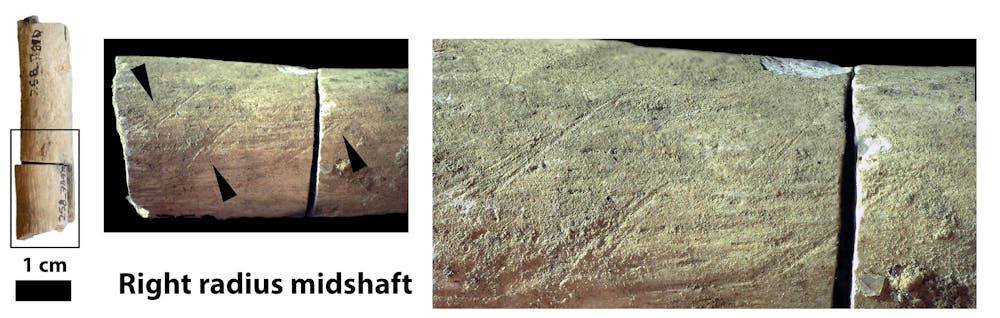
Patterns of warping, cracks, and discoloration attributable to hearth injury confirmed her physique was burned with some flesh nonetheless on it in a hearth reaching at the least 1,000 levels Fahrenheit (540 levels Celsius). Beneath the microscope we may see tiny incisions alongside her arms and at muscle connections on her legs, revealing that individuals tending the pyre used stone instruments to assist the method alongside by eradicating flesh.

Justin Pargeter
Inside the pyre ash, we discovered many small pointed chips of stone that prompt folks had added instruments to the hearth because it burned.
And the way in which the bones have been clustered inside such a big hearth confirmed that this was not a case of cannibalism: It was another sort of ritual.
Maybe most surprisingly, we discovered no proof of her head. Skull bones and teeth usually preserve well in cremations as a result of they’re very dense. Whereas we will’t know for positive, the absence of those physique elements suggests her head might have been eliminated earlier than or through the cremation as a part of the funeral ritual.
A communal spectacle
We decided that the pyre should have been constructed and maintained by a number of individuals who have been actively engaged within the occasion. Throughout new excavations the next 12 months, we discovered much more bone fragments from the identical historical lady, displaced and coloured in another way from these in the primary pyre. These further stays recommend that the physique was manipulated, attended, and moved through the cremation.
Microscopic evaluation of ash samples from throughout the pyre included blackened fungus, reddened soil from termite constructions, and microscopic plant stays. These helped us estimate that individuals collected at the least 70 kilos (30 kg) of deadwood to do the duty and stoked the hearth for hours to days.
We additionally realized that this was not the primary hearth on the Hora 1 website—nor its final. To our astonishment, what had appeared throughout fieldwork to be a single large pile of ash was in truth a layered collection of burning occasions. Radiocarbon courting of the ash samples confirmed that individuals started lighting fires on that spot by about 10,240 years in the past. The identical location was used to assemble the cremation pyre a number of hundred years later. Because the pyre smoldered, new fires have been kindled on prime of it, leading to fused ashes in microscopic layers.

Flora Schilt
Inside a number of hundred years of the primary occasion, one other massive hearth was constructed once more at the very same place. Whereas there is no such thing as a proof that anybody else was cremated within the subsequent fires, the truth that folks repeatedly returned to the spot for this goal suggests its significance lived on in neighborhood reminiscence.
A brand new view of historical cremation
What does all of this inform us about historical hunter-gatherers within the area?
For one, it exhibits that complete communities have been engaged in a mortuary spectacle of extraordinary scale. An open pyre can take greater than a day of fixed tending and an enormous amount of fuel to totally cut back a physique, and through this time the sights and smells of burning wooden and different stays are unimaginable to cover.
This scale of mortuary effort is sudden for this time and place. Within the African document, complicated multigenerational mortuary rituals tied to particular locations are usually not associated with a hunting-and-gathering lifestyle.
It additionally exhibits that completely different folks have been handled in several methods in demise, elevating the potential for extra complicated social roles in life. Different males, ladies, and youngsters have been buried on the Hora 1 website starting as early as 16,000 years in the past. The truth is, these different burials have offered historical DNA proof exhibiting they have been a part of a long-term local group. However these burials, and others that got here a number of hundred years after the pyre, have been interred with out this labor-intensive spectacle.
What about this particular person was completely different? Was she a beloved member of the family or an outsider? Was this therapy due to one thing she did in life or a selected hope for the afterlife? Extra excavation and information from throughout the area might assist us higher perceive why this particular person was cremated and what cremation meant to this group.
Whoever she was, her demise had necessary that means not simply to the individuals who made and tended the pyre, but additionally to the generations that got here after. 
Jessica C. Thompson, Assistant Professor of Anthropology, Yale University; Elizabeth Sawchuk, Curator of Human Evolution of the Cleveland Museum of Pure Historical past and Analysis Assistant Professor of Anthropology, Stony Brook University (The State University of New York), and Jessica Cerezo-Román, Affiliate Professor of Anthropology, University of Oklahoma.
This text is republished from The Conversation underneath a Inventive Commons license. Learn the original article.
Trending Merchandise

Lenovo Latest 15.6″ Laptop co...

Thermaltake V250 Motherboard Sync A...

Dell KM3322W Keyboard and Mouse

Sceptre Curved 24-inch Gaming Monit...

HP 27h Full HD Monitor – Diag...

Wi-fi Keyboard and Mouse Combo R...

ASUS 27 Inch Monitor – 1080P,...

Lenovo V14 Gen 3 Enterprise Laptop ...

Amazon Fundamentals – 27 Inch...